The two-year-old's rebellion: how to respond to anger and the constant "no"
Tantrums and a "no" to every question are normal in a two-year-old, not a parenting failure. See what's happening in your child's head and how to respond calmly, without escalation or punishment.
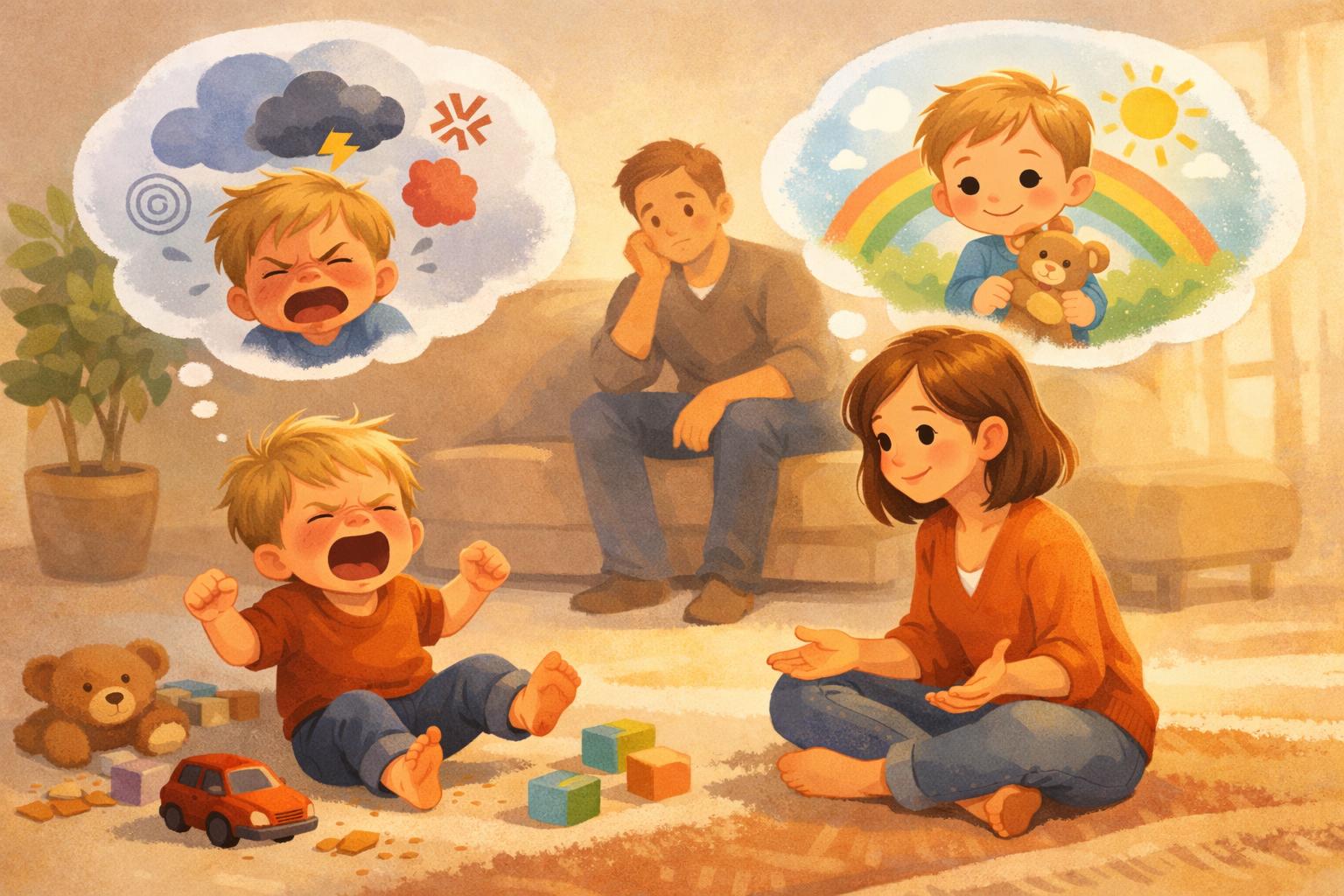
Your smiling little one has, seemingly overnight, turned into someone who throws themselves on the floor in the shop and answers every suggestion with a booming "no". Welcome to the two-year-old's rebellion. It's exhausting, but completely normal — a sign your child is starting to discover themselves as a separate person with a will of their own. You don't have to "win" it. You have to get through it together with your child.
What's really going on in a two-year-old's head
A two-year-old's brain develops faster than their skills can keep up with. Your child feels enormous emotions — frustration, anger, disappointment — but doesn't yet have the tools to name or manage them. The part of the brain responsible for self-control is only just forming and will keep maturing for many years.
On top of that comes the discovery of their own separateness: "I'm my own person, I can decide." Hence that famous "no" — often thrown out even when the child actually does want what you're offering. It isn't spite. It's a rehearsal of their own will.
A tantrum isn't a problem to be solved
When a child is mid-tantrum — screaming, crying, arching their back — their brain is "flooded" with emotion. In that moment, explaining, negotiating or setting conditions doesn't work, because the part responsible for logic is offline. Your job then isn't to teach but to weather the storm and provide a sense of safety.
- Get down to their level. Crouch, speak quietly and slowly.
- Name the feeling. "You're very angry because you wanted to stay longer."
- Stay close. Some children want a cuddle, others need space — stay nearby, calm.
- Don't give in on the principle. You can have compassion for the feeling and still hold the boundary: "I know this is hard. We're leaving the shop."
Your calm is contagious — and so is your tension. A child "borrows" from you the regulation they don't yet have themselves.
How to reduce the number of outbursts
Many tantrums can be prevented before they start. This isn't about avoiding boundaries, but about picking your battles wisely:
- Offer a choice within safe limits. Instead of "get dressed", say "do you want the red hoodie or the blue one?". Your child feels a sense of agency.
- Give warning before transitions. "In five minutes we're finishing the game." A sudden stop is a common trigger.
- Mind the basics. Hunger and tiredness are fuel for tantrums — predictable meals and sleep reduce their number.
- Say what you want, not what you don't. "We walk indoors" works better than "don't run".
- Choose what truly matters to you. The fewer the prohibitions, the more weight they carry.
When "no" chases "no"
If your child refuses everything, don't get into a verbal tug-of-war. Humour and play help: "I'll carry this sock to the shoe like a rocket!". You can also redirect attention or offer an illusion of control ("do we go jumping or on tiptoe?"). Sometimes the best answer to "no" is calm, kind action instead of discussion.
After the storm: the most important moment
When the emotions subside, come back to your child. Cuddle them and briefly name what happened: "That was really hard for you. It's all right now." You don't need to give a lecture or revisit the wrongdoing — the child will remember little of it anyway. It's precisely in these calm moments after a tantrum that the sense is built that emotions are safe and your relationship is stronger than any outburst.
Be gentle with yourself
The two-year-old's rebellion can exhaust the most patient parent. You'll raise your voice or react worse than you'd like — that's normal. You can then repair the relationship with a simple "I'm sorry, I was tired". A child learns not from your perfection but from how you return to balance. This hard stage will pass, and what you build now — calm, closeness, predictable boundaries — will last for a long time.